Two entrepreneurs open businesses in the same week: one a small brewery, the other a supermarket that, among other goods, will also sell wine and cigarettes. Both assume they need a license from the state. In reality, the matter is arranged far more intricately, and this is precisely where most people get confused.
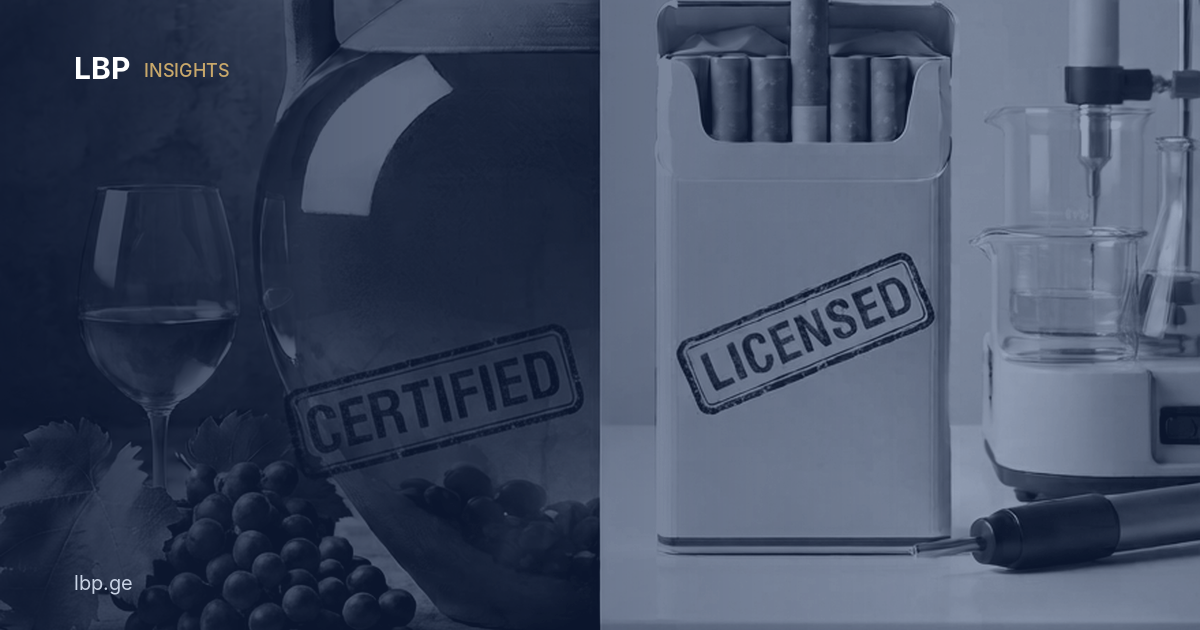
The alcohol and tobacco sector in Georgia is strictly regulated, but this regulation is built on two entirely different mechanisms: tobacco production is actually governed by classic state licensing, while alcohol falls under a certification regime. This distinction is often forgotten, because both intuitively bring to mind the same term "license."
Tobacco production, which is licensable
The Law "On Tobacco Control" directly stipulates: the production of smoking tobacco and cigarettes requires a tobacco production license. A license is not required only for the import of tobacco products and for production by a natural person for personal consumption. To obtain the license, an enterprise needs its own laboratory, compliant with legally defined standards, for quality control of its products, this condition is one of the strictest in the entire sector. The license holder is obligated to carry out the full production cycle, and skipping any individual stage is already considered a violation of the license conditions.
This is not the only source confirming this, the general framework law currently in force, "On Licenses and Permits," which exhaustively lists all state-licensable activities in Georgia, separately names the "tobacco production license" as a distinct item. Anyone who produces or starts producing tobacco today without a license and the corresponding laboratory is directly violating the law.
Alcohol - certification
Here is an interesting detail: the exhaustive list of licenses currently in force does not include the production of alcohol or wine at all. This means that, in the classic, technical sense of the term, "license" no longer applies to alcohol production - the center of regulation has been shifted to a different mechanism, certification.
Since January 1, 2023, alcoholic beverages intended for sale on Georgia's domestic market are subject to mandatory certification. This is overseen by the National Wine Agency - before releasing each batch onto the market, the producer or seller must ensure that a certificate of conformity for the product is obtained, which the Agency issues on the basis of a protocol from an accredited laboratory. The purpose of certification is maximum control of alcoholic beverages and protection of the consumer market from falsification.
In practical terms, this means that an alcohol producer or seller does not need to obtain a state license in the sense established for tobacco, but without certification, the sale of the product on the domestic market is not permitted. These are two different legal mechanisms, though the practical outcome, the obligation to undergo state control before entering the market is similar.
Why a store or bar doesn't need a separate permit
Retail trade, whether we are talking about alcohol or tobacco, is not included in Georgia's exhaustive list of licensable activities. If a store or bar simply sells already manufactured or certified products and does not itself produce anything, obtaining a separate state license is not required.
But "the absence of a license" does not mean the absence of control. Restrictions applicable to the retail level, particularly for tobacco, are scattered across other legislation:
- Restriction on the location of an establishment near childcare and educational institutions
- Prohibition on selling to minors
- Display restriction - tobacco products must not be visible from outside the establishment through a counter, shelf, or display window
- Mandatory warning at the point of sale about health risks and the prohibition on selling to minors
Violation of these rules is followed by real, concrete fines, for example, the Code of Administrative Offenses provides separate liability specifically for the sale of tobacco near an educational institution or for selling directly to a minor.
Conclusion
In the field of alcohol and tobacco, Georgian legislation uses two different instruments. Tobacco production is strictly licensed, with a laboratory requirement, an obligation to complete the full production cycle, and a prohibition on operating without a license. Alcohol production, on the other hand, bypasses the licensing mechanism and instead falls under a mandatory certification regime, overseen by the National Wine Agency. In both cases, retail trade is free from licensing but is burdened with other types of restrictions: location-based, age-based, and information-related requirements, the disregard of which is just as risky as operating without a license.
An entrepreneur planning tobacco production, alcohol production, or the opening of a retail chain in this sector often needs not knowledge of a single universal procedure, but precise differentiation: which mechanism applies to which product, licensing or certification, which in practice requires more than knowledge of individual laws.