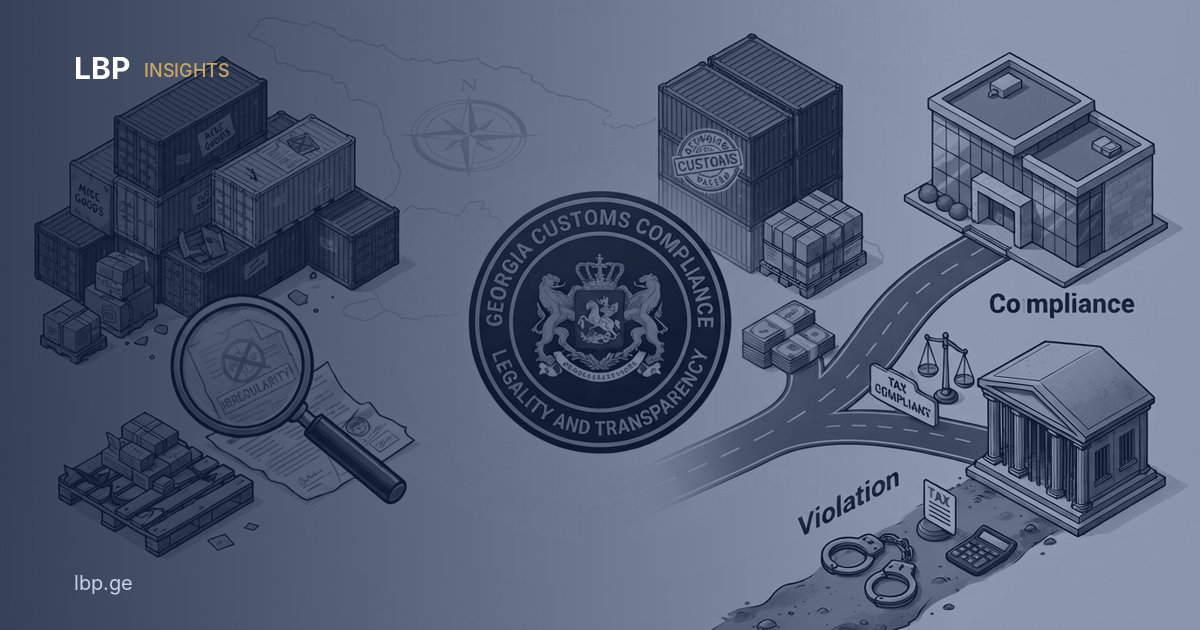
A late declaration, an incorrectly selected commodity code, an inaccuracy in an accompanying document, this is often considered a simple technical mistake. In reality, however, a customs rule violation in Georgia can lead to two entirely different outcomes: in one case, a monetary fine, in the other, a criminal case. Where the line is drawn and who bears responsibility, the company or a specific individual, these are the questions a business risks facing without an answer.
Administrative sanctions under the Tax Code
Article 289 of the Tax Code is the central norm governing customs offenses. It covers three typical violations.
For late declaration, if a person violates the deadline for presenting goods, general declaration, or notification of a means of transport, the fine amounts to 50 GEL for each day of delay, but no more than 1000 GEL. It is a small fine, but for a regular importer each delay is counted separately.
Incorrect data in the declaration. If, due to incorrect data in a customs declaration or accompanying documents, the payable import/export tax was reduced, the declarant or their representative will be fined in the amount of 100% of the reduced sum, with a minimum of 1000 GEL. For a repeated violation, the rate increases to up to 200%, with a minimum of 2000 GEL.
Undeclared goods. When goods that were not declared at all are discovered during customs control, the law provides for a fine in the amount of the full customs value of these goods, this means that the company effectively loses a sum equal to the value of the imported goods. In court practice this is one of the most frequently applied norms: for example, a passenger was fined the full customs value of the goods for undeclared gold and silver items discovered when a handbag was scanned at a land border checkpoint.
It should also be noted that the general statute of limitations rule applies to customs sanctions as well, which is 3 years from the end of the calendar year in which the violation was committed.
When does a customs violation qualify as smuggling
An administrative fine and a criminal offense differ from each other on a fundamental level. Article 214 of the Criminal Code, "Violation of the rule related to the movement of goods across the customs border of Georgia," takes effect when goods are moved across the border in a large amount by bypassing customs control, concealed from it, through deceptive use of a document or means of identification, or by entering false data in a customs declaration.
The law recognizes two thresholds: a large amount and a particularly large amount, the threshold is determined by value. Goods with a customs value exceeding 15,000 GEL already qualify as a "large amount," the punishment is a fine or deprivation of liberty for a term of 3 to 5 years. For a value exceeding 25,000 GEL, the punishment is 5 to 7 years. Separately, even stricter rules apply to items of cultural heritage, precious metal articles, and dangerous substances, and in cases of repeated commission, abuse of official position, group commission, or an organized group, the punishment can reach as much as 8 to 15 years.
The company or the individual
Here lies an interesting nuance. The fine is paid by the importing company, this is unambiguous. In criminal matters, however, Georgian legislation builds the liability of a legal entity on a separate principle: according to the Criminal Code, the basis for the criminal liability of a legal entity is determined by the corresponding norms of the Code, this means that a legal entity bears responsibility for a crime only if this is specifically indicated in the relevant article. Article 214 of the Criminal Code does not indicate liability of a legal entity, accordingly criminal liability is borne personally by a specific natural person, the director, the declarant, or another responsible employee, who carried out the unlawful act in the name of or for the benefit of the legal entity. The company, meanwhile, remains subject to the financial sanction.
Conclusion
Customs regulation is a technical field, where one incorrect field can turn into a monetary fine, while intentional concealment can become grounds for deprivation of liberty. The two directions, administrative and criminal, operate separately and must be assessed individually: how accidental the violation is, what value of goods is at stake, and who specifically bears responsibility. Attending to the accuracy of the declaration process is a far cheaper solution than fighting a fine or a case afterward.