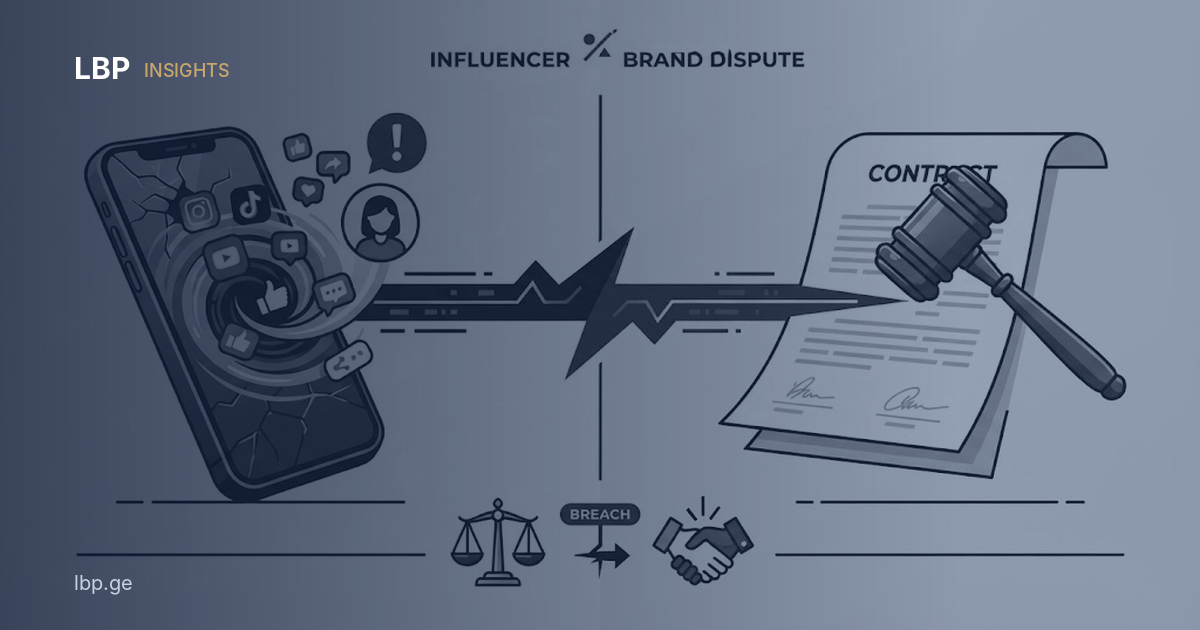
The brand pays the influencer to advertise a product, and the influencer does not publish the post, publishes it late, or publishes something different from what was agreed, or the reverse: the content has already spread, collected thousands of views, but the brand does not pay. Both situations are quite common, and behind both stands the same problem: the collaboration was either never recorded in writing at all, or was recorded in just a couple of sentences in messages.
Georgia does not have a special law that would directly regulate influencer contracts. These disputes are resolved within the framework of ordinary contract law and advertising legislation.
Analysis
The agreement between an influencer and a brand is, in essence, a service contract: one party agrees to do a specific piece of work, for example, a post, a story, a video, and the other agrees to pay a sum of money. The Civil Code regulates this relationship through its general rules, regardless of whether the contract is signed or the parties simply agreed in a chat. The absence of a written form does not release anyone from the obligation; correspondence is accepted as evidence in court, and so is a payment receipt.
In legal practice, disputes arise over the same set of issues: the content was not published or was published late; it was published but does not match the technical brief, wrong tag, wrong message, an entirely different platform; the brand did not pay the agreed fee; the influencer deleted the post before the deadline; or advertised a competing brand while the exclusivity clause was still in effect.
A separate issue is who advertises the product to the consumer, and how. The Law "On Advertising" prohibits misleading and unethical advertising, regardless of the channel. If an influencer's post creates a false impression of the product for the consumer, not only the brand but the influencer too bears responsibility. That is why omitting the "advertising partnership" disclosure is not only an ethical problem, but a legal one as well.
After a breach, the injured party has several options. They can demand compensation for damages, incurred expenses, and lost profit. If a penalty clause was written into the contract, the matter becomes simpler: proving the amount of damage is no longer necessary at all, the fact of the breach is enough. In the case of an essential breach, a party can also withdraw from the contract and get back what was paid. But often reputation matters more than money, a public dispute on social media is costly for both sides, which is why a large share of cases never even reach court and end in a settlement.
One simple conclusion remains: the more thoroughly and clearly the details are spelled out in the contract: how many posts, by what date, with what technical requirements, when and how payment is made, whether exclusivity applies or not, the less room is left for a dispute.
Conclusion
A dispute between an influencer and a brand is, in most cases, an ordinary contractual dispute, for which the law offers tools such as compensation for damages, a penalty clause, and withdrawal from the contract. The problem arises earlier, for example, when writing the contract, or, more often, when it does not exist at all. One well-written page is often enough for a dispute never to start.